
 | |||||||
 |
 POLITICS


January 25, 1999
 |
Lawyer from Belgrade
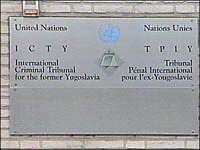
Legal and moral credibility of the International Criminal Tribunal for the former Yugoslavia in Hague had been the subject of numerous discussions already before this institution was established. Establishing of the Tribunal was disputable as well as its functioning in practice later on.
Considering that unlegitimacy of the Tribunal establishing goes without saying, here we would like to point out two new problems in its functioning.
First, we are most probably discussing about the most significant temptation that the Tribunal faced with and which, in relation to the events in Kosovo; it had to solve in advance. It is the prerequisite for the Tribunal to get the minimum not only of legal, but also of moral credibility for further decision making, especially concerning Kosovo.
NATO pact passed the decision to commit crimes anticipated by the Tribunal Bylaws. The United States of America, Great Britain, the Netherlands and some other states, through their greatest representatives, individually made decisions to commit crimes prescribed by the Bylaws of the Tribunal. They still threaten with these crimes. Falker Rhea, then Tony Blair, Madeleine Albright and others say in a loud manner that crimes prescribed by the Tribunal Bylaws should be committed.
Results of each military aggression on the Federal Republic of Yugoslavia by some foreign force, without permission and corresponding decision of the Security Council, certainly is a subject of responsibility for war crimes prescribed by the Bylaws of the Hague Tribunal. There is the competence of the Tribunal in all four forms: ratione personae, ratione loci, ratione temporis and ratione materiae.
As for the personal competence, first, it is prescribed that for the acts anticipated by the mentioned Bylaws all persons could be responsible, regardless to the nation they belong to. If they could be Serbs and Albanians, even more they could be Germans, Englishmen, Americans and all others. In this case really there is not any obstacle for anybody who is not citizen of SRY to be responsible for any crime prescribed by the Tribunal Bylaws.
Further on, the territorial competence, according to the Tribunal Bylaws, covers all acts performed in the territory that covers the area of the former SFRY.
As for the time competence, it is prescribed to apply the Bylaws for acts committed from 1991, for unlimited time and certainly nowadays as well.
Finally, military attack on SRY, which was and still is threatening, certainly is covered by regulations of Article 2. (Especially items a.,c., and d. of the Bylaws), dealing with severe violations of Geneva Conventions from 1949. That even made the job of the Tribunal easier (in contrast to occurrences in Kosovo) owing to the request the conflict to be international and that victims and aggressors have different citizenship.
No doubt that the crime from Article 3. of the Bylaws, as residual provisions covering all war crimes that are not covered by Articles 2.,4., and 5. of the Bylaws, would be committed as well.
In case there were more victims and destructions, anyhow the responsibility for crimes against humanity (Article 5. Of the Bylaws) and genocide (Article 4. Of the Bylaws) would apply.
In the planned action for committing the stated crimes there are elements as of direct responsibility of concrete perpetrators (Article 7., item 1. of the Bylaws) so of all their seniors, that is commanders (Article 7., item 3. of the Bylaws).
We are pointing out that the crime of genocide from Article 4. of the Bylaws is committed even by inducing, attempt and conspiracy for committing the same (in this case it can be determined having in mind volume and funds of planned actions). The Tribunal should reconsider and evaluate that.
What was the plan of the attack and what could happen?
NATO has anticipated over 600 targets in SRY. For the existence of acts from the Bylaws often it is not relevant if the targets are military or civilian ones. But we have to mention that the military targets include bridges, roads and other traffic facilities, which are planned for the beginning of attack. With full hope that it would be done very precisely and in a small area, the victims, normally civilian, would be enormous. And, SRY would certainly respond to this attack with arms and all participants and their territories should have to be considered as war enemies. The military response of SRY would induce the further response of NATO pact or the U.S.A. and Great Britain, and, certainly, with military assistance of Russia or Belarusa, possibly direct, response to response, until unimagined conflicts and unimagined victims and destructions occur. Maybe until the new world war starts.
By the way, in these critical days, these threats, sent primarily through media in a really unscrupulous manner, lead to despair of a great mass of people, including children and thousand hundreds of refugees. From Belgrade only several hundred of thousands people escaped at that time. However, the Tribunal at the same time behaved as it was not concerned at all. The Tribunal was not interested in bombing of a nation and a state although it is the crime by its Bylaws.
These days, more precisely on 9th and 12th October 1998, that is in the most critical period, the author of this article sent two identical telefaxes to the esteemed lady McDonald, by which he informed her that in his opinion these acts are within the competence of the Tribunal and asked her to prevent them. There was no reply. For the author it is not of much importance, but it is very important whether these letter had any effect at all or not.
The Tribunal was established on the basis of the Chapter VII of the United Nations Charter with the following title: " Actions against threats of peace, violations of peace and acts of aggression". In its resolutions on establishing the Tribunal, the Security Council stated that the aim of the Tribunal must be to contribute restoration and maintenance of peace. The Tribunal in its first annual report from 1994 points out that it has the triple aim: to pronounce the justice, to prevent further crimes and to contribute to restoration and maintenance of peace.
However, the Tribunal at least through its Prosecutor, only comes out for its competence for the acts of the SRY in Kosovo, that is in its territory, but not for the same and much more complicated and even worse acts of, for instance, the U.S.A., Great Britain and Germany against the SRY and its citizens in that Kosovo, as well as in wider area of the whole state. Is it logical?
Is there any need to appear in the Tribunal which teaches us, on the basis of its Bylaws, that there is the aggression of the Yugoslav National Army, the institution founded by all republics of the former SFRY, on Bosnia and Herzegovina and Croatia, then that Serbs from B&H and Croatia are aggressors in their own country, while the same does not exist when the attack of the U.S.A., Great Britain and other countries on SRY is concerned? Such an opinion of the Tribunal we can characterize only as extremely facetious and amoral by which the Tribunal loses all its credibility.
The Tribunal must clearly explain this. It also must acknowledge that the explanation is "post festum" and that the mistake was in favor of potential criminals. In case the Tribunal keeps its position that it is competent for occurrences in Kosovo only when the responsibility of the citizens of SRY is concerned, while it is not competent when the responsibility of foreign citizens as aggressors in the same Kosovo is concerned, the following conclusion is only possible: with extremely biased court institution, which not only in legally wrong manner, but also in amoral way interprets regulations of its own Bylaws, it is possible to discuss only from the aspect of the application of the Convention on removal of all forms of racial discrimination (from 1965). In our opinion that Convention deals with this kind of discrimination as well.
Second, at the moment the most actual is the issue of the board of judges which passed judgment in the "case of Celebici". As it is known, the first accused was acquitted, the second accused was sentenced to prison for seven years, while the third and the fourth accused were sentenced to prison for 20 and 15 years, respectively. That is the sentence for the most severe crimes and bestial steam letting off, while Serbian victims - Serbs from B&H practically were pronounced aggressors in their own country. It is enough only to compare crimes and sentences in this case and the case of Tadic and to see that one member of the Serbian people from B&H for less severe acts had much more severe legal action and sentence.
However, the Serbian side, which observed the trial, could not expect anything better from such a board of judges. One of the main causes of conflicts in B&H was the difference of religions, which is the unanimous opinion of leading world experts.
Let us see then, in the light of that fact, who decided about crimes of three Muslims and one Catholic over Orthodox people in Celebici camp.
The board of judges consisted of two Catholics and one Muslim, but from two Muslim and one Catholic country, that is judges from Pakistan, Nigeria and Costam Rica, while the judge from Nigeria, although the Muslim country is concerned, is a Catholic. As for the judge from Costa Rica we have to add the following: out of approximately 200 countries, only three have completely broken diplomatic relations with SRY on account of the alleged aggression on B&H. They are Costa Rica, Malaysia (Which also has its judge in the Tribunal) and New Zealand. Mrs. Odio Benito, the judge from Costa Rica, is the current Vice-president of the government of her country, the former minister of justice and the judge of the Supreme Court.
In this case, such a composition of the board of judges is disgraceful for the international legal system and any comment of the verdict of this board of judges is secondary and superfluous.
- Basic principles of the international law violated
- Tribunal is a framework for political goals of the powerful
- Legal and moral credibility of the Tribunal in Hague
- The Hague Tribunal and the crimes on Kosmet - Orwellian fantasy of powerful people
- Democracy Development Fund Sends Letter to Gabriella Kirk McDonald, Judge of the Hague Tribunal
- Hague Tribunal trump card for blackmailing
- Verdict in Celebici case is political sentence to FR Yugoslavia and Serbs
- Deceiving Role of Prosecution in Celebici Case
- Delalic's Acquittal Closes the Path to Izetbegovic
- Yugoslav Army in municipality of Konjic wasn't involved in the conflicts
- Dragan Gagovic - another Serb secretly accused and killed, without a right to defend himself
[ Home | Encyclopedia | Facts&Figures | News ]
Copyright © 1998, 1999 Ministry of Information
Email: