
 | |||||||
 |
 POLITICS


January 25, 1999
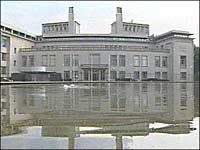 |
"Hiding of these political interests of certain countries and legitimacy of the tribunals in the world public was made possible by the war atrocities and crimes that were really committed in former Yugoslavia during the war. However, it shows that such a tribunal, just like the ad hoc tribunal for Rwanda, is intended primarily to judge the outcasts of the international community, while permanent members of the Security Council can do whatever they seem appropriate, without any obligations, says Stojanovic. According to him, that was also confirmed by the conference about trials for war crimes that was last weekend organised by the Fund for humanitarian law in the "Intercontinental" hotel, because the participants did not state any new arguments in favour of legal worthiness, i.e. legitimacy of the tribunal.
On the contrary, no world or local expert that has critical, different stance towards the tribunal was not invited to attend the conference, not even those who have a balanced stance when the legal and expert interpretation for founding and operation of such a tribunal is in question, reminded Stojanovic. He pointed out that achieving of the political function of the tribunal was hindered by its very low level of connection to the law, because the tribunal has only 34 articles out of which majority deals with regulating organisational issues, and only ten or so of them having basic criminal law provisions.
"The prosecutor, in this case Louise Arbour, is in no way bound while assessing if and who she will start proceedings before the tribunal. In that regard she has unlimited authority and can only answer to the Security Council that appoints her. Curios are the secret indictments that the prosecutor can open, which are not allowed in the criminal proceedings of any civilised country, stressed Stojanovic.
That is why, assesses Stojanovic, regarding the legal basis for founding and, the set goals and rudimentary law that the tribunal is applying, that tribunal remains a special accessory body of the Security Council, a forced measure and disciplinary committee, not a criminal court.
Stojanovic added that the tribunal's attempt to apply some kind of law was in fact a conglomerate of common international law, "general legal principles", provisions of some international conventions that are by themselves often unclear and controversial, they are opinions of a part of doctrine and judicial practice of individual countries, often less important or that do not represent the prevailing opinion, even the stances that the tribunal has taken in resolving concrete issues.
When we are speaking about the specific five-year work of the tribunal, which is unsatisfactory, Stojanovic primarily stresses the fact that the basic reason for that is the alleged non-co-operation of former Yugoslav republics, first of all Yugoslavia and Republika Srpska with the tribunal.
The alleged non-co-operation of Yugoslav authorities with the tribunal is based, according to Stojanovic, on the flaws of the tribunal as the legal institution, i.e. it concerns the discussion about if the international criminal law in the sense of supranational law was possible.
"That co-operation was not accomplished only in one, but extremely important and sensitive issue, and that is extradition of a country's citizens. Only when other countries accept the obligation to extradite their citizens and when the tribunal's law is on the level of FR Yugoslavia and other European countries' criminal laws, there would exist legal arguments for reconsideration of FR Yugoslavia's stance, stresses Stojanovic.
Just for reminder, only 20 countries have so far adopted new regulations in the aim of "accomplishing co-operation" with the tribunal, not showing readiness to carry out the tribunal's orders without delay.
Germany has, for example, passed a Law on co-operation with the tribunal, but under it only foreign citizens can be extradited and not German citizens. Other countries made a similar legal "gymnastics", most frequently accepting that the local court discusses about The Hague Tribunal's request for extradition.
Stojanovic stresses that the breaking point that could be marked as the beginning of creation of international criminal law was the adoption of the Statute of the International criminal court, on July 17, 1998, in Rome. The Statute was adopted at the diplomatic conference of UN ambassadors on the founding of the criminal court and was open for signing to all states.
The international criminal law cannot be made by norms that would be adopted only by a number of countries in order to punish the citizens of other states. The state is the bearer of laws, so one should be pleading for the international criminal law to represent the synthesis of the bast comparative-legal solutions of the important legal systems, i.e. national legislation, concluded Stojanovic.
- Basic principles of the international law violated
- Tribunal is a framework for political goals of the powerful
- Legal and moral credibility of the Tribunal in Hague
- The Hague Tribunal and the crimes on Kosmet - Orwellian fantasy of powerful people
- Democracy Development Fund Sends Letter to Gabriella Kirk McDonald, Judge of the Hague Tribunal
- Hague Tribunal trump card for blackmailing
- Verdict in Celebici case is political sentence to FR Yugoslavia and Serbs
- Deceiving Role of Prosecution in Celebici Case
- Delalic's Acquittal Closes the Path to Izetbegovic
- Yugoslav Army in municipality of Konjic wasn't involved in the conflicts
- Dragan Gagovic - another Serb secretly accused and killed, without a right to defend himself
[ Home | Encyclopedia | Facts&Figures | News ]
Copyright © 1998, 1999 Ministry of Information
Email: